 This reading concentrates on networking, but this is difficult to understand by itself.
Castells defines networks as "appropriate instruments for a capitalist economy based on innovation, globalization, and decentralized concentration; for work workers, and firms based on flexibility and adaptability; for a culture of endless deconstruction and reconstruction; for a polity geared toward the instant processing of new values and public moods; and for a social organization aiming at the supersession of space and the annihilation of time" (2001: 502).
McNeill and McNeill (2003) came up with a series of 5 web structures determining world history. The progression to successive webs was driven initially by biological necessity (i.e, to avoid inbreeding), but also by a desire to discover and access materials to improve life. Not only was information exchanged, but also "goods, technologies, ideas, crops, weeds, animals and diseases" (Van Dijk, 2006: 22). The sequence of webs began with hunter gatherer tribal networks (a key shared idea was the control of fire) to the current global web expedited by exponential improvements in communications, culminating in computers, networks and the Internet.
Nowadays, there is a decentralized network in society in terms of distributing information. Van Dijk describes this as " a static and hierarchical organization" (2006: 24). Nowadays, we have social networking available to us, through the use of websites such as Facebook and Twitter, which "are available at all levels and subsystems of society" (Van Dijk, 2006: 25). However, Kontopoulos makes "distinction between hierarchical and heterarchial modes of organization of the world". The base of the hierarchical structure has thickened rather widened, because so many people are connected, with little scope for expansion, but the volume of information exchange is increasing.
Let me give you an example of how beneficial networking is. 50 years ago, indexers for books would be tied to the publisher or restricted by the limitations of mail. Nowadays, similar workers work at home, whether in London or Shetland, and have immediate access to sources, colleagues and feedback. Working at home is clearly conducive to some people's preferred lifestyle (and also furthers the Green Revolution).
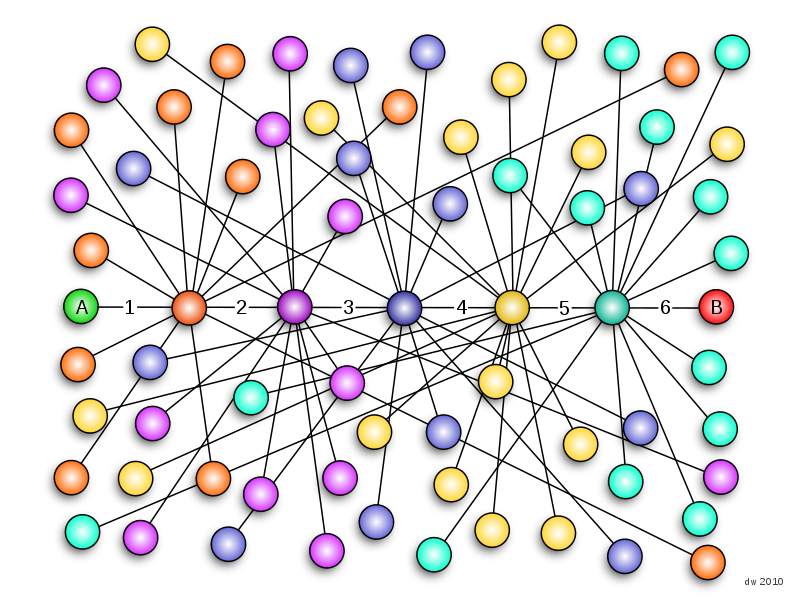
Diagrammatic representations of networks abound, though two dimension scarcely does justice to the complexities, particularly of distributed network chains, typified by social networking. Research by Stanley Milgram and others into the "small world experiment" give fascinating conclusions that could not have been realised during earlier stages of historical web development. Six degrees of separation illustrates how any individual is but six steps away from any other individual on earth through personal association (relationships). Relationships of two therefore build to networks of three or (infinitely) more. Being a friend of a friend takes on a new light and we really need to choose our friends carefully.
If the world's population is 7 billion, if you sat at the head of a pyramid with only 44 friends and one of those friends had in turn 44 unique friends (plus a few duplicates!), and each one of these a further 44, then you are linked to each everyone in the world by just six steps.
⁶√(7,000,000,000) ≈ 43.7
Reference list
- Castells, M. (2001) The Rise of the Network Society. Oxford: Blackwell.
- McNeill, J.R. and McNeill W. (2003) The Human Web: A Bird's-Eye View of World History. London: W. W. Norton & Co.
- Van Dijk, J. (2006) "Networks: The Nervous System of Society" in The Network Society. London: Sage.
- Burnett, R. and Marshall, P.D. (2003) Web Theory: An Introduction. London: Routledge.
- Van Dijk, J. (2006) "Networks: The Nervous System of Society" in The Network Society. London: Sage.

No comments:
Post a Comment